
Disclosure: I built Linkilo, a competing internal link plugin. I used Link Whisper for over two years before building my own solution, so this review comes from genuine hands-on experience rather than a surface-level comparison. If you purchase Link Whisper through links in this article, I may earn a commission at no extra cost to you.
You have published 200 articles. Maybe 500. You know internal links matter for SEO because you have read the case studies and seen the data. But every time you publish something new, a familiar dread settles in. You need to go back through dozens of old posts, hunt for places to add links to this new piece, and then link the new piece back to relevant content that already exists.
Internal links at scale work like a library where every new book needs to reference relevant books that already exist, and those books need updated references to the new arrival. This happens manually, every single time, unless you automate it.
Link Whisper promises to solve this bottleneck. After using it across multiple sites with 800+ articles, here is the complete picture of what works, what falls short, and whether it deserves your investment in 2026.
What Is Link Whisper and How Does It Work
Link Whisper is a WordPress plugin that automates internal link creation. It scans your entire website and suggests relevant internal links you can add with a single click. Spencer Haws of Niche Pursuits built it and later sold the company, and has said publicly that he is no longer involved, so it is now run by new owners. The 50,000-plus install figure you see quoted is the counter on the free WordPress.org listing rather than the paid plugin.
The plugin acts as a matchmaker for your content. When you write an article about “best espresso machines,” Link Whisper identifies every article on your site that mentions espresso, coffee, or related terms, then suggests links between them.
The technical process behind link suggestions
When you understand the match system, you understand both Link Whisper’s strengths and limitations.
The core match system extracts keywords from your post titles and custom target keywords you set. If your post is titled “How to Make Apple Pie: An Ultimate Guide,” the system strips common words and searches your site for what remains: “how,” “make,” “apple,” “pie.”
When the system finds a sentence like “I want to make some coffee that tastes like apple pie,” it suggests a link from that phrase to your apple pie article. The sentence discusses coffee, not pie. The keyword match is technically accurate but contextually wrong.
That was the old behavior, and it is worth being clear that it has changed. Version 2.7.0 moved Link Whisper to embedding-based semantic matching, so it compares meaning rather than counting shared words. Its changelog shows further work through 2026 adding sentence-to-content relatedness checks and pre-filtering before suggestions reach you.
The practical result is fewer of the obviously wrong matches described above. Reviewing suggestions is still worth your time, as it is with any tool of this kind, but the keyword-only criticism no longer applies.
Every Link Whisper Feature Explained
Feature lists on sales pages rarely tell the full story. Here is what you actually get based on two years of daily use.
How internal link suggestions work in practice
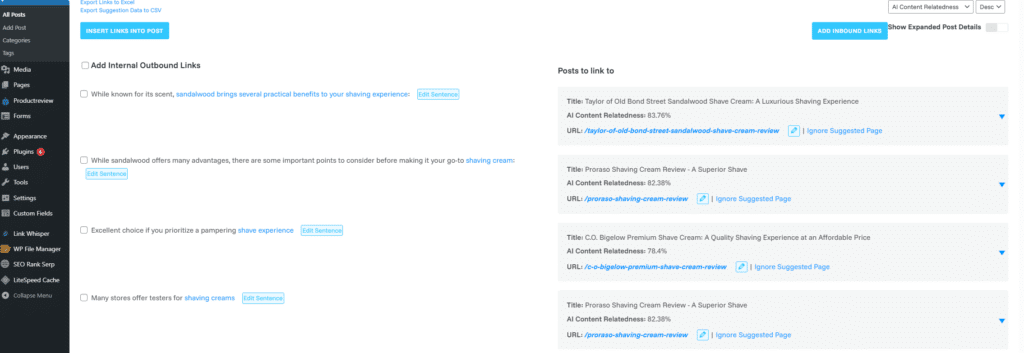
When you open any post in WordPress, Link Whisper displays a panel at the bottom showing suggested internal links. Each suggestion shows the target URL, anchor text, and the sentence where the link would appear. Check a box, click “Add Links,” and the links get inserted.
Genuine strengths from two years of use: the plugin surfaces link opportunities you would never find manually on sites with 200+ posts. Anchor text is fully customizable before insertion. You can add multiple links at once, which matters when you process a backlog of orphan content. Compatibility with Elementor, Divi, and Thrive works reliably, notable because many plugins break with page builders.
Weaknesses that emerged over time: suggestion relevance still varies by niche, with informational content outperforming product reviews where model numbers and versions matter. Suggestions can only be filtered by tags and categories, so on a large mixed site you sort through a fair amount that does not fit. And because there is no record of how often an anchor phrase is already used, nothing flags a suggestion that repeats wording you have leaned on elsewhere.
Why you should avoid the auto-link feature

Link Whisper includes an automatic link feature where you specify a keyword and URL, and the plugin links that keyword everywhere it appears across your site.
Skip this feature. Here is the specific scenario that changed my mind: I targeted “ristretto” to link to my ristretto coffee guide. The plugin linked that word everywhere, including sentences like “This ristretto coffee maker features…” where I actually needed to link to the coffee maker review page. Blanket auto-links create spammy patterns that confuse both users and search engines about what each page covers.
If you have used this feature extensively, audit those links. Check anchor text relevance, verify you have not over-linked the same phrase, and confirm the contextual fit makes sense for readers.
What the link reports dashboard shows you
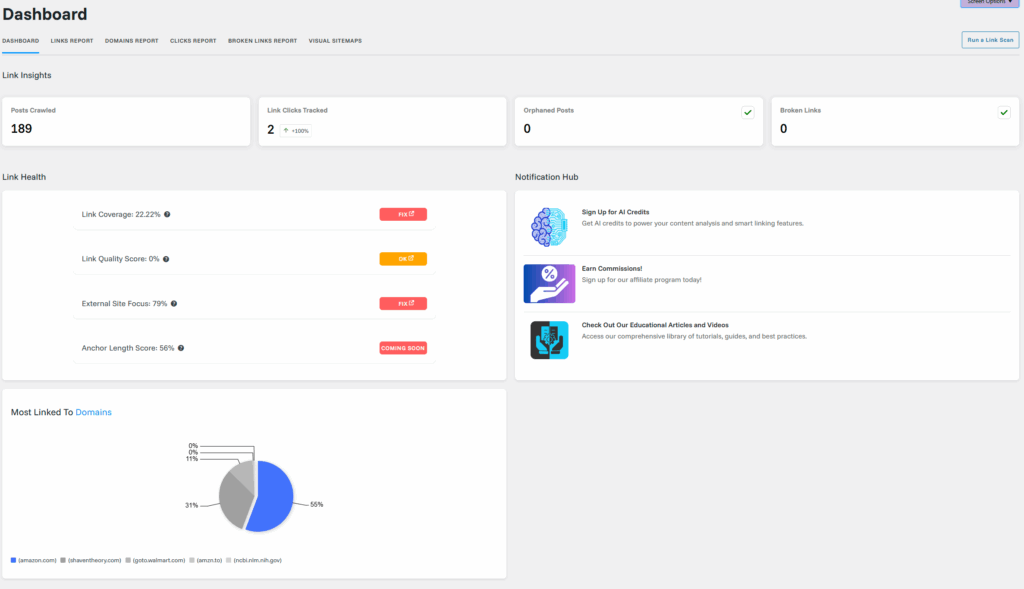
The reports dashboard shows link statistics for every post: inbound internal links, outbound internal links, and external links. You can quickly identify orphan pages (posts with zero internal links pointing to them) and over-linked content.
Orphan pages are an SEO blind spot. Pages with no internal links pointing to them often struggle to get indexed and ranked. The dashboard makes them visible. Finding and fixing orphaned pages produced some of my quickest rank wins because Google started to reach content that had sat dormant for months.
New features added in 2025 and 2026
Click Analytics tracks which internal links visitors actually click. This data shows what content your audience finds valuable and which links might need repositioning for better visibility.
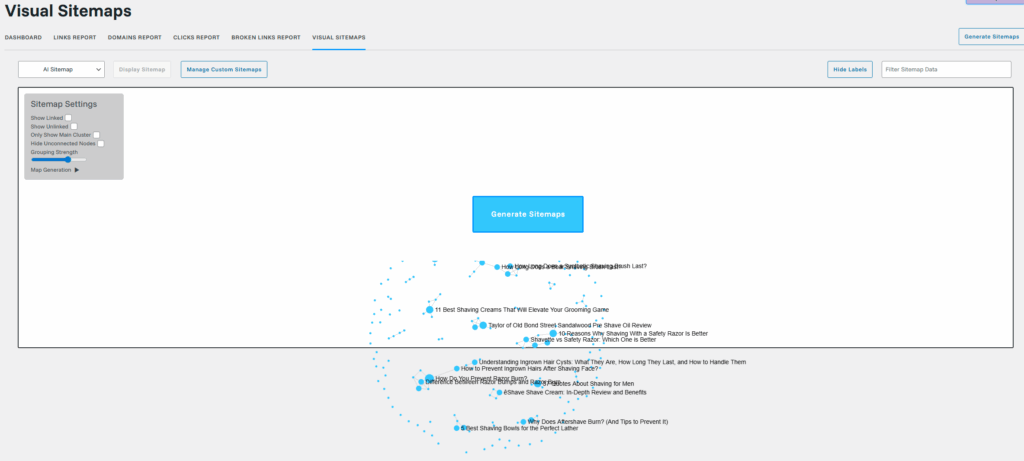
Visual Sitemaps display how your pages connect through internal links. Useful for spotting isolated content clusters or pages with disproportionate link distribution.
Broken YouTube Detection identifies when embedded YouTube videos become unavailable, something most broken link checkers miss entirely. Useful for sites with significant video embeds in older content.
Google Search Console Integration pulls rank keywords directly from GSC so you can use them as target keywords. This eliminates guesswork about what terms Google associates with your pages.
External Site Links provides cross-site link suggestions if you own multiple sites running Link Whisper, helping build topical relevance across a portfolio of related properties.
How Much Link Whisper Costs in 2026
Prices have increased since the plugin’s earlier years. Based on the official Link Whisper pricing page, here are the current annual costs.
Link Whisper pricing 2026
All plans include a 60-day money-back guarantee. Discount codes that save $15 to $20 appear periodically.
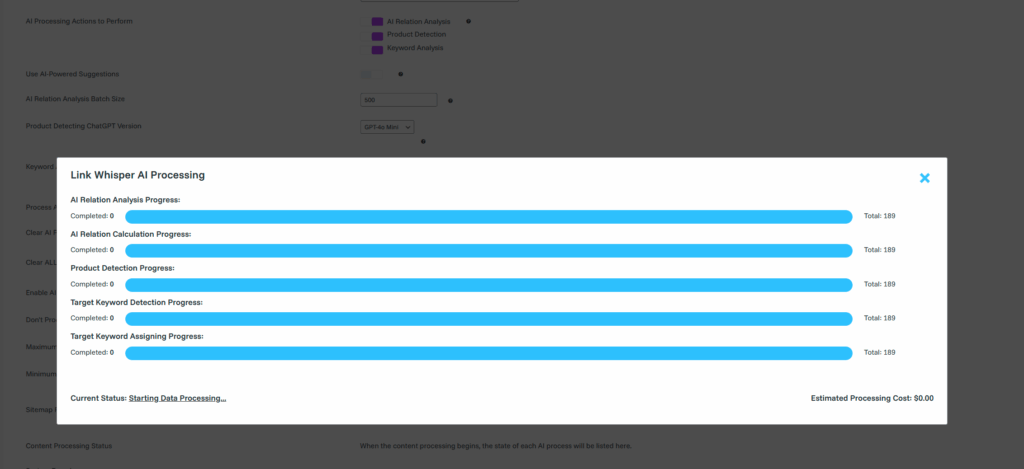
The AI model changed twice. Link Whisper originally used your own OpenAI key, then began bundling credits, and its June 2026 update retired the direct OpenAI connection entirely. AI features now run on Link Whisper credits included with each tier, so costs are predictable but capped. Watch your credit use if you process a large archive in one go.

What the free version does and does not include
Link Whisper offers a free version on the WordPress.org plugin directory, and that listing is where the widely quoted 50,000-plus install count comes from. The free version is essentially a demo: basic link suggestions, no auto-links, no broken link detection, limited reports. For meaningful internal link work, you need the paid version.
The Strengths That Make Link Whisper Worth Considering
After using Link Whisper across multiple sites for over two years, these are the genuine strengths.
Speed of link insertion transformed my workflow. What previously took 20 to 30 minutes per article now takes 2 to 3 minutes. For sites that publish two or more articles per week, this compounds into significant time saved over a year.
Index improvements appeared within weeks. New content got found and indexed noticeably faster after I added consistent internal links through the plugin, which aligns with Google’s documentation about how internal links help crawlers understand site structure.
Orphan page auditing revealed forgotten content. The reports dashboard showed pages with zero internal links that were invisible to search engines. Fixing them produced some quick rank improvements because Google started reaching content that had sat dormant for months.
No lock-in. Link Whisper creates standard HTML links rather than JavaScript redirects. If you deactivate the plugin, all links remain exactly where you placed them. You build genuine site architecture rather than dependency on a plugin to maintain your links.
Page builder compatibility works reliably. The plugin integrates with Elementor, Divi, Thrive Architect, and other popular builders without broken layouts or conflicts. Because many plugins fail when page builders are involved, this compatibility provides real value.
The Weaknesses That Made Me Build an Alternative
These limitations drove me to build Linkilo after two years of daily use.
No anchor text tracking
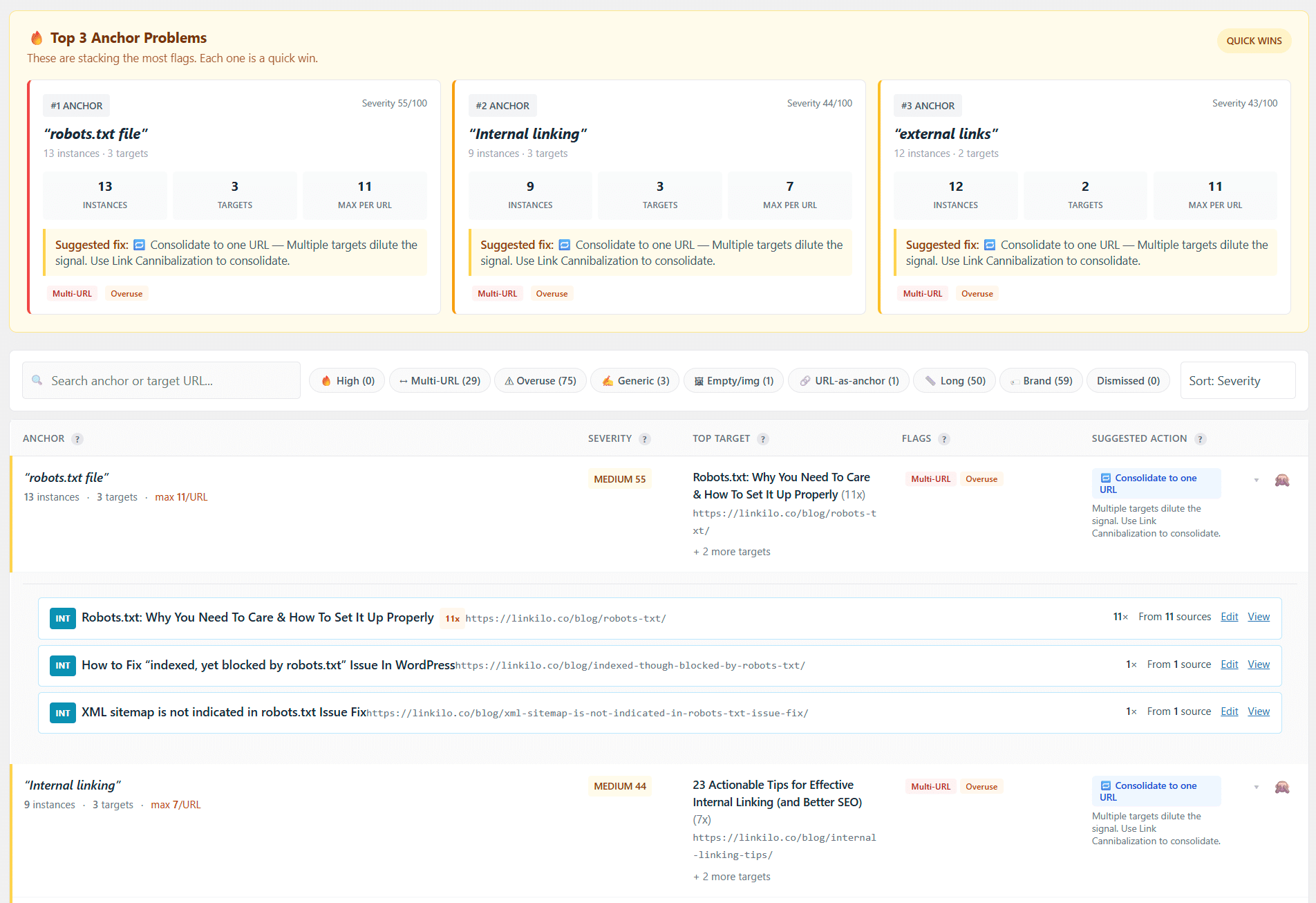
Link Whisper does not track how many times you have used specific anchor text across your site. Over-optimized anchor text, using the exact same phrase repeatedly, can trigger algorithmic penalties. Without anchor text reports, you might link to your “best coffee makers” page with that exact phrase 50 times without realizing it. I found this problem on one of my sites only after a manual audit that took several hours.
No cannibalization detection
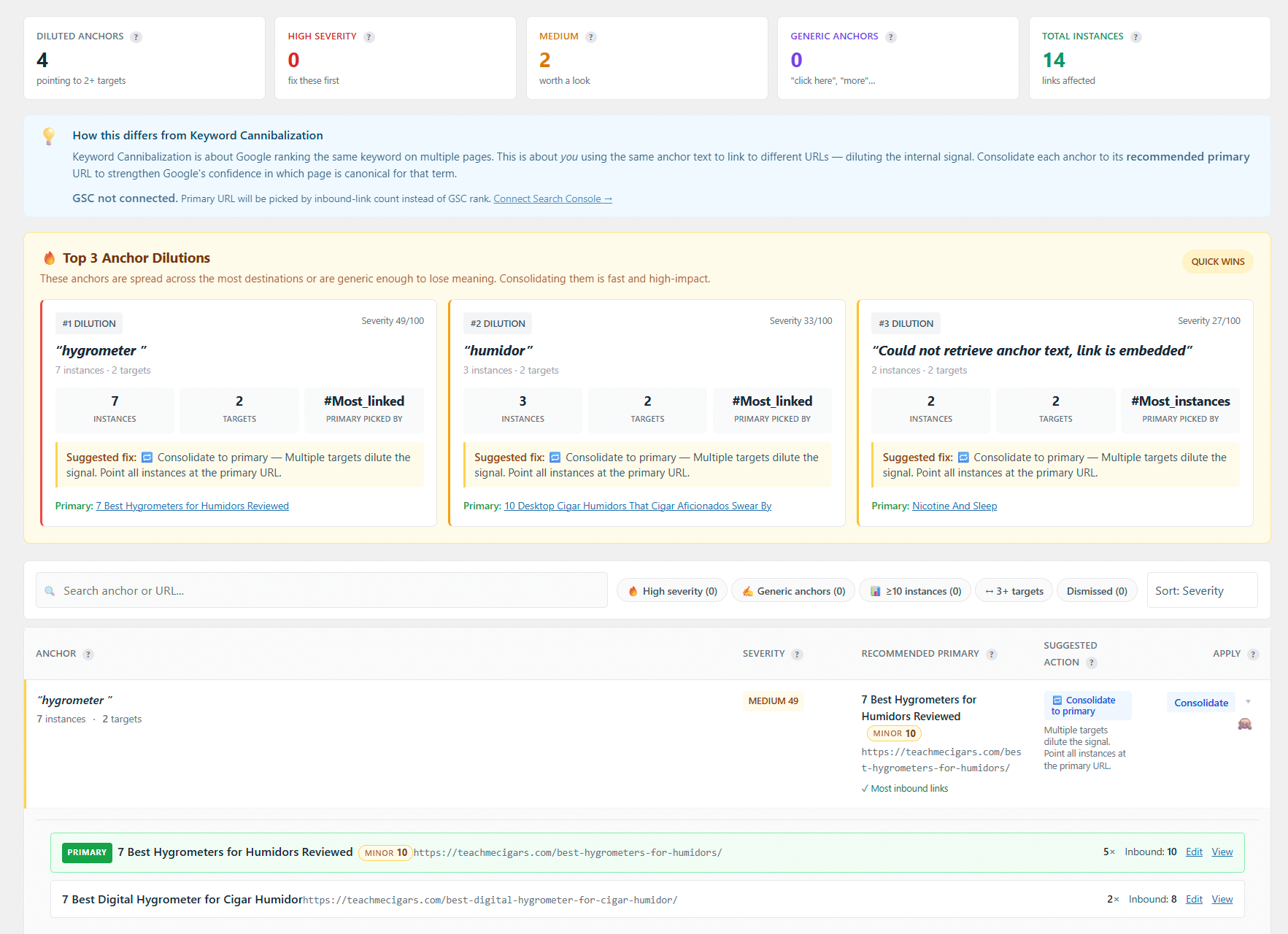
I encountered this repeatedly: using the same anchor text (“pour over coffee”) to link to two different articles, which tells search engines both pages compete for the same keyword. Internal competition dilutes rank potential for both pages. Linkilo’s Link Cannibalization Report surfaces every anchor text pointing to more than one URL, ranked by recovery potential. Link Whisper has no equivalent.
Filters limited to tags and categories only
Suggestions can only be filtered by tags and categories. There is no way to filter by exact-match keywords or exclude specific content types like product pages from informational link suggestions. More manual sorting through irrelevant suggestions is the result.
The AI now runs on credits rather than your own key
Link Whisper originally connected to your own OpenAI account. Its June 2026 update retired that direct connection and moved everything to the Link Whisper AI service, so the AI features now draw on credits bundled with your plan.
That makes costs predictable, which some people prefer. The trade is that you no longer control the model or see the actual usage cost, and heavy processing on a large site is bounded by the credits in your tier.
No visibility into what the suggestion does to the rest of your site
This is the gap that matters most now that the matching itself has improved. A suggestion is evaluated on whether two pages are related, not on what accepting it does to your wider link profile.
Nothing checks whether the anchor is already pointing at a different URL, whether you have used that phrase thirty times, or whether the target is the weaker of two pages competing for the same term. You find out later, during an audit, if you run one.
Persistent marketing notifications
A recurring theme in WordPress.org reviews is frustration with persistent marketing elements, review request banners that will not dismiss and promotional notifications in the WordPress admin. These accumulate over daily use and erode the overall experience.
How Link Whisper Compares to the Alternatives
If Link Whisper’s limitations concern you, several alternatives address different needs and budgets.
Linkilo
I built Linkilo to address the gaps I ran into when using Link Whisper daily. It starts at $59/year for a single site versus Link Whisper’s $97 and includes features Link Whisper does not offer: keyword cannibalization reports, anchor text analysis, a crawl log analyzer showing when Googlebot last visited each URL, and topic cluster visualization. The 25-site license at $279/year is strong value for agencies compared to Link Whisper’s $497 for 50 sites.
Limitations worth noting: no free tier (30-day refund only), fewer user reviews than Link Whisper’s established base, and a 2021 launch versus Link Whisper’s 2019 debut.
Internal Link Juicer the strongest free option

With over 80,000 active installations and a 4.7/5 rating on WordPress.org, Internal Link Juicer offers strong free functionality including keyword-based automatic links and anchor text variation without payment required. The tradeoff is setup complexity. Configuration requires more manual work and you lose the suggestion-based workflow that makes Link Whisper intuitive for beginners.
Yoast SEO and Rank Math
Both major SEO plugins include internal link suggestions in their premium versions, but they only suggest links. You still have to manually find where to place them. These function as suggestion tools rather than link management systems. For sites already on Yoast or Rank Math premium, the built-in suggestions might cover basic needs. For dedicated internal link workflows on sites with 100+ articles, purpose-built tools deliver significantly more value.
Side-by-side comparison
Link Whisper vs Linkilo vs Internal Link Juicer
Why Internal Links Actually Improve Search Rankings
Before you invest in any internal link tool, here is the evidence behind why this matters.
Authority Hacker’s analysis of 1,000,000 internal links found a clear correlation between internal link count and rank position. Pages with more internal links pointing to them consistently ranked higher than pages with fewer.
Google’s own documentation confirms this. Internal links help Google find new pages, understand site structure, and pass PageRank throughout your site. A well-linked page signals importance to search algorithms, which influences how Google prioritizes content in results.
After adding systematic internal links on sites with 200+ articles, I consistently saw improved crawl rates, faster indexation of new content, and gradual rank improvements for previously neglected pages. The compound effect over 6 to 12 months was significant enough that I now treat internal links as a foundational SEO activity rather than an optional optimization.
The question for most site owners is not whether internal links matter but whether you can do it at scale. Manual linking becomes impractical around the 100-article mark, which is where tools like Link Whisper earn their value.
Is Link Whisper Right for You
Link Whisper makes sense if you have 100+ published articles and struggle to maintain internal links manually, publish frequently (2+ articles per week) and need to reclaim time spent on links, outsource content uploads and need a system that works without deep site knowledge, or want a proven tool with extensive documentation and community support.
Link Whisper might not fit if you need anchor text analysis and cannibalization detection for advanced SEO work, run an SEO agency that requires detailed link audit reports, have a tight budget and prefer alternatives starting at $59/year or free, manage 25+ sites where costs compound significantly, or need crawl log analysis to understand how Google interacts with your content.
Final Verdict After Two Years of Daily Use
Link Whisper delivers on its core promise. It saves time on internal links and surfaces opportunities you would miss manually. For sites with substantial content libraries, this efficiency has real value that compounds over months of consistent use.
The move to semantic matching was a meaningful upgrade, and the 2026 updates on top of it closed most of the gap between what the plugin suggests and what a person would pick. The 60-day money-back guarantee gives you a risk-free trial, and it is a long-established product with an active user base behind it.
For serious SEO work across multiple sites or client accounts, the analytical gaps matter. No anchor text tracking, no cannibalization detection, and no crawl analysis means you build internal links without visibility into whether those links create problems downstream.
If you are new to internal link automation, Link Whisper is a reasonable starting point. If you have outgrown basic link suggestions and need comprehensive audit capabilities, compare it head-to-head with Linkilo before deciding.
Key Takeaways
- Link Whisper saves 20 to 30 minutes per article on internal linking and is worth the cost for sites publishing 100+ articles regularly
- Matching moved from keywords to meaning in version 2.7.0, with sentence-level checks added through 2026, so suggestion quality is much improved on the original system
- Skip the auto-link feature entirely; it links keywords without context and creates spammy patterns
- The orphan page report is one of the most valuable features, fixing zero-link pages often produces quick rank improvements
- Link Whisper has no anchor text analysis or cannibalization detection; for advanced SEO work those gaps matter
- For agencies or multi-site operators, Linkilo’s pricing and feature set makes more sense above the 3-site tier
Frequently Asked Questions About Link Whisper
Common questions about features, pricing, and how it compares to alternatives
+What is Link Whisper and how does it work?
Link Whisper is a WordPress plugin that automates internal link creation. It scans your entire site and suggests relevant internal links you can add with a single click. The plugin extracts keywords from your post titles and custom target keywords, then searches your site for matching content to suggest links between them.
+How much does Link Whisper cost in 2026?
Link Whisper offers four annual tiers: Starter at $97/year for 1 site, Growth at $197/year for 3 sites with 1,000 AI credits, Pro at $297/year for 10 sites with 5,000 AI credits, and Agency at $497/year for 50 sites with 10,000 AI credits. All plans include a 60-day money-back guarantee.
+Does Link Whisper have a free version?
Yes, on the WordPress.org plugin directory, and that free listing is the source of the 50,000-plus install figure often quoted for Link Whisper. It functions as a demo with basic link suggestions but no auto-links, no broken link detection, and limited reports. For meaningful internal link work, the paid version is required.
+Should I use the auto-link feature?
No. The auto-link feature links keywords everywhere they appear without considering context. If you target a word like ristretto, it might link that word in sentences about coffee makers where you actually need to link to the coffee maker review. Blanket auto-links create spammy patterns that confuse users and search engines.
+How accurate are Link Whisper suggestions?
Better than they used to be. Version 2.7.0 moved the plugin to embedding-based semantic matching, and later 2026 updates added sentence-level relatedness checks, so the obviously wrong matches from the old keyword system are much rarer. Reviewing each suggestion is still worthwhile, since no tool knows which of your pages you are about to retire or consolidate.
+What happens if I deactivate Link Whisper?
All links remain exactly where you placed them. Link Whisper creates standard HTML links rather than JavaScript redirects, so there is no lock-in. You keep the genuine site architecture you built rather than depending on the plugin to maintain your links.
+How does Link Whisper compare to Linkilo?
Linkilo starts at $59/year versus Link Whisper $97 and includes features Link Whisper lacks: keyword cannibalization reports, anchor text analysis, crawl log analyzer, and topic cluster visualization. Link Whisper has more user reviews and a longer track record (2019 vs 2021). Choose Link Whisper for established simplicity; choose Linkilo for advanced SEO analytics.
+Does Link Whisper work with page builders?
Yes, reliably with Elementor, Divi, and Thrive Architect without broken layouts or conflicts. This is notable because many plugins fail when page builders are involved, making Link Whisper a solid choice for sites using visual editors.
Linkilo does this for you
- AI Internal Link Suggestions : Get link suggestions a human editor would approve, and add them in one click without leaving the editor.
- Anchor Text Reporting Tool : See every anchor pointing at every page, and catch the over-optimized ones before Google does.
- Crawl Log File Analyzer : See exactly which pages Google and the AI crawlers actually visit, inside WordPress, with no log files to download.

Jay - Linkilo
Jay's the brains behind cool tools like Linkilo, helping marketers rock their SEO game. He's all about data-driven strategies and using AI to boost results. He's been at this for a decade and loves figuring out what works (and what doesn't) to get more leads without paying a fortune. <a href="https://www.linkedin.com/in/jay-kang-80b103309/">Linkedin</a>