
Internal linking affects three things that directly control your rankings: which pages Google finds and indexes, how authority flows across your site, and how clearly Google understands your content hierarchy. Most sites treat it as an afterthought. That’s where the opportunity is.
Common Internal Linking Problems That Hurt SEO

The problems that show up most often on sites with 100+ pages are all variations of the same root issue: no system. Anchor text is either too vague (“click here”) or keyword-stuffed to the point Google flags it. Orphan pages sit with zero inbound internal links, invisible to crawlers unless they happen to be in the sitemap. Link equity pools on the homepage while pages that actually need authority to rank get none of it. And user experience suffers because readers hit dead ends instead of finding the next logical piece of content.
Key SEO Metrics Affected by Internal Linking
Here is what internal linking actually moves, metric by metric.
Organic Visibility
A page stuck on page three is often there because it has no internal links from stronger pages pointing to it. Linking to it from pages that already rank passes authority and gives Google a clearer signal about what the page covers. The anchor text matters here. “Learn more” tells Google nothing. “SEO audit checklist for WordPress sites” tells Google exactly what it will find. Linkilo’s AI suggestions surface relevant linking opportunities as you write, so you don’t have to manually scan your archive every time you publish something new.
Crawlability and Indexing
Google has a crawl budget. Pages that are more than a few clicks from the homepage or that have no internal links pointing to them often don’t get crawled as frequently, which means they don’t get indexed as quickly either. The fix is straightforward: link to those buried pages from your homepage or from high-traffic posts that Google visits often. Linkilo’s Orphan Page Finder lists every published page with zero inbound internal links so you can prioritize which ones to rescue first.

PageRank and Link Equity Distribution
Your homepage likely has the most external backlinks pointing to it. Without a deliberate internal linking strategy, that authority stays there. Pages that need to rank for competitive terms never get the equity they need. Point contextual internal links from your high-authority pages toward your money pages and cornerstone content. Keep the link count per page reasonable so each link still passes meaningful value. Linkilo’s suggestions are weighted by post similarity and topic cluster signals, so the links it recommends are contextually relevant rather than just any page on your site.
User Engagement and Bounce Rate
A reader who finishes a section and has nowhere obvious to go next will leave. A reader who sees a relevant link at exactly the right moment will click. That difference shows up in your bounce rate and time on site. The links that perform best are the ones that feel like a natural extension of what the reader just finished, not a generic “related posts” widget at the bottom. When the anchor text describes something the reader actually wants to know next, the click happens without friction.

Conversion Rate
Internal links are one of the most direct paths from informational content to conversion pages. A reader who finds your blog post through search is not ready to buy yet. But if that post links to a case study, and the case study links to a pricing page, you have built a funnel with no additional content required. Link your top-performing posts to the pages where conversions happen. Make the anchor text describe the value of the destination, not just its name.
Site Structure
Internal links create your site’s hierarchy in Google’s eyes. A page linked from the homepage with a descriptive anchor carries more weight than a page buried four clicks deep with no links pointing to it. Use internal links to connect related pages, establish topical clusters, and distribute authority to pages that target your most important keywords. When the structure is logical, Google maps it quickly. When it’s a mess, important pages get ignored.
How Linkilo Handles Each of These Problems
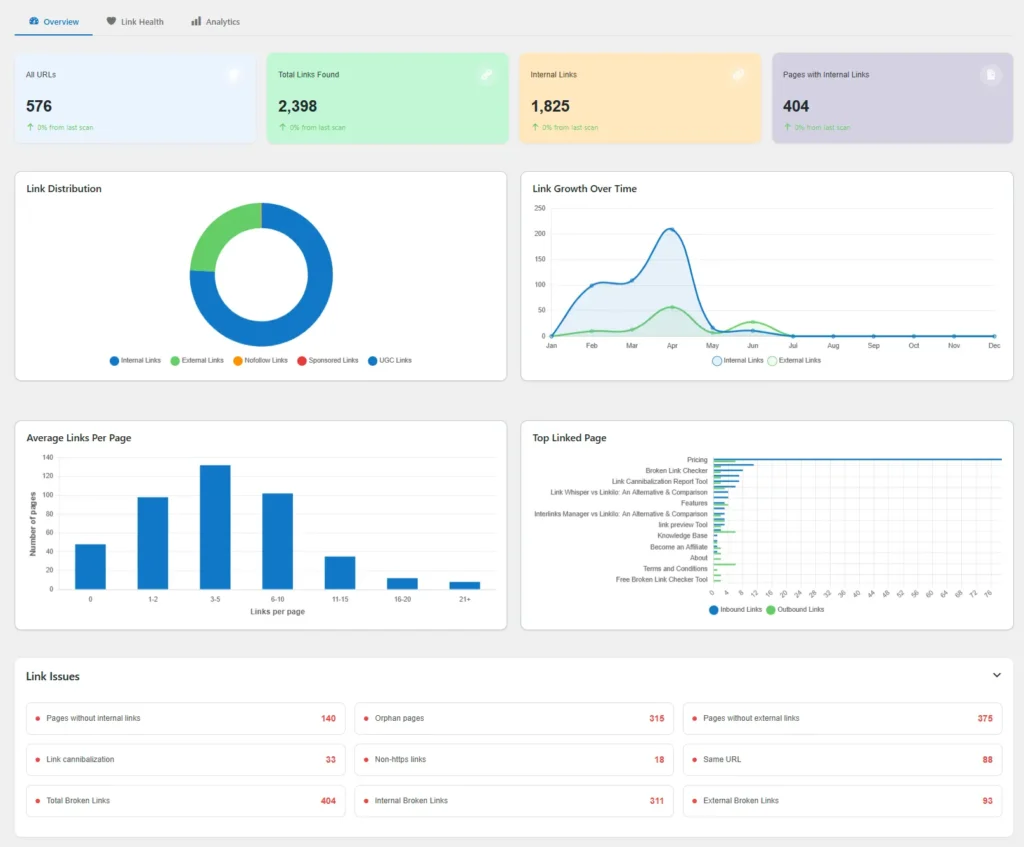
Linkilo runs inside your WordPress admin. Here is what it handles automatically:
- Anchor text over-use: Linkilo’s Anchor Text Analysis shows every anchor phrase across your site and how many times each has been used, so you can diversify before over-optimization becomes a problem.
- Anchor text cannibalization: Linkilo’s Link Cannibalization Report catches anchor phrases pointing to multiple different pages, splitting the ranking signal you are trying to build. It shows which page should own each anchor and lets you consolidate in one click.
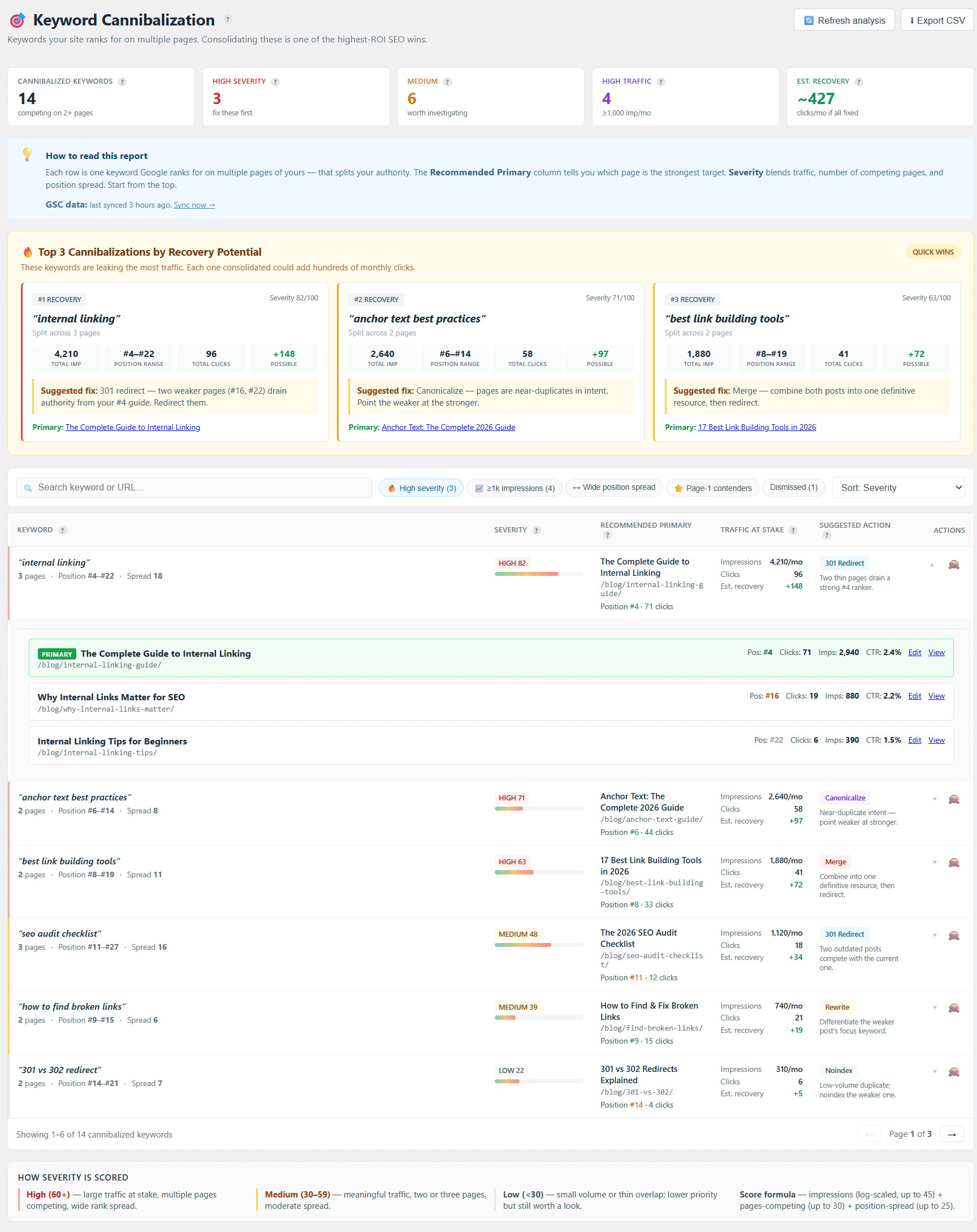
- Keyword cannibalization: Linkilo’s Keyword Cannibalization Report syncs with Search Console and surfaces every query where two or more pages are competing for the same ranking, scored by impressions, competing pages, and position spread.
- Uneven link equity: AI Link Suggestions surface contextually relevant pages to link to while you write, based on post similarity, keyword overlap, and topic cluster signals.
- Orphan pages: The Orphan Page Finder lists every published page with zero inbound internal links, grouped by post type, so you know exactly where to add links first.
- Structural issues: The link count and distribution reports show where pages have too many links diluting equity and where important pages are under-linked.
Linkilo works on WordPress only. If your site is on a different platform, the reporting features won’t be available to you.
| Problem | How Linkilo Fixes It |
|---|---|
| Vague or over-optimized anchor text | Anchor Text Analysis shows usage across every post so you can diversify |
| Same anchor pointing to multiple pages | Link Cannibalization Report finds splits and consolidates in one click |
| Uneven authority distribution | AI suggestions push equity toward pages that need it most |
| Orphan pages not getting crawled | Orphan Page Finder lists them instantly, grouped by post type |
| Keyword cannibalization in search results | Keyword Cannibalization Report syncs with GSC to surface competing pages |
Linkilo does this for you
- AI Internal Link Suggestions : Get link suggestions a human editor would approve, and add them in one click without leaving the editor.
- Anchor Text Reporting Tool : See every anchor pointing at every page, and catch the over-optimized ones before Google does.
- Internal Link Click Analytics : Find out which internal links people actually click, and stop guessing which ones earn their place.

Jay - Linkilo
Jay's the brains behind cool tools like Linkilo, helping marketers rock their SEO game. He's all about data-driven strategies and using AI to boost results. He's been at this for a decade and loves figuring out what works (and what doesn't) to get more leads without paying a fortune. <a href="https://www.linkedin.com/in/jay-kang-80b103309/">Linkedin</a>