Interlinks Manager Review: The WordPress Plugin That Actually Shows You What’s Working
 Jay - Linkilo

You know what’s interesting about most internal linking plugins? They promise to automate everything, but they never show you the results.
It’s like having a personal trainer who tells you to do exercises but never measures your progress. Sure, you’re doing something, but you have no idea if it’s actually working.
That’s where Interlinks Manager comes in. And honestly, it took me a while to appreciate what makes this plugin different.
Most people want the flashy AI stuff. The plugins that promise to read your mind and create perfect links automatically. But some website owners actually want to understand what’s happening behind the scenes. Some prefer data over guesses.
Think about it this way. You could have a plugin that creates 100 internal links and tells you “trust me, these are good.” Or you could choose one that creates 50 links and shows you exactly how much SEO value each one is passing around your site.
That’s the choice you’re making here.
What Is Interlinks Manager?

DAEXT built this plugin back when people still cared about understanding their data. They’ve been making WordPress tools since 2012, which means they’ve seen every SEO trend come and go.
The plugin comes in two flavors:
- Free version that covers basic internal linking
- Pro version for $39 that unlocks analytical power
But here’s what most reviews won’t tell you. This plugin focuses on understanding your internal link structure like a scientist would, not just creating links like every other tool does.
When was the last time you wondered which pages on your site were getting the most link juice? Or which internal links people actually click on? Most plugins can’t answer those questions.
The Features That Actually Matter
Before we dive into the technical details, let me explain what sets this plugin apart from everything else in the market. While most internal linking plugins focus on automation or simple keyword matching, Interlinks Manager takes a completely different approach. It treats your website like a complex system where every link has measurable value.
The plugin offers four core capabilities that you won’t find combined anywhere else. Each one addresses a specific problem that most website owners don’t even realize they have.
Link Juice Analysis That Makes Sense
Every SEO talks about link juice, but how many have actually seen it calculated?
Interlinks Manager assigns each page something called “SEO Power.” Think of it like a credit score for your content. The plugin then shows you exactly how much of that power flows through each internal link.

The plugin doesn’t just count links. It calculates the actual SEO value being passed around your site.
Let’s say you have a high-authority page about WordPress security. When that page links to your hosting guide, the plugin shows you exactly how much SEO value that link transfers. You can see which pages are getting the most benefit and which ones are being ignored.
Why does this matter? You might discover that your most important pages aren’t getting the internal linking they deserve.
Click Tracking That Tells Stories
Most plugins create links and disappear. This one actually tracks what happens next.
Every time someone clicks an internal link, the plugin records it. IP address, timestamp, source page, destination page. It builds a complete picture of how people move through your content.
You know those internal links you spent hours on? Now you can see if anyone actually clicks them.
| Tracking Feature | What It Shows | Why It Matters |
|---|---|---|
| Click timestamps | When people engage | Find your peak engagement times |
| Source/destination | Navigation paths | Understand user journey |
| Geographic data | Where clicks come from | Optimize for your audience |
| User agent info | Device/browser data | Mobile vs desktop behavior |

Systematic Link Creation
The automatic linking works differently here. Instead of just matching keywords, you set up rules.

You can target:
- Specific categories and post types
- Custom fields and metadata
- Date ranges and publication status
- Complex keyword patterns with regex
Want to automatically link all your product reviews to your main review page? Set up a rule. Need to connect related tutorials? Another rule.
But here’s the smart part. The plugin includes safeguards. It won’t over-optimize your content or create spammy link patterns. You set the limits, and it respects them.
Professional Reporting
This is where agencies fall in love with the plugin.
Everything exports to CSV:
- Every link with source and destination
- Click data with timestamps
- SEO value calculations
- Performance metrics over time
When you need to explain internal linking ROI to a client, this plugin gives you the numbers to make that conversation easy.
What It Costs and Why
Let’s talk money, but more importantly, let’s talk about what you’re actually buying. The pricing structure reflects a completely different philosophy from most WordPress plugins. Instead of charging you monthly forever, they ask for one payment and give you lifetime access to a tool that gets better over time.
The free version handles basic internal linking for smaller sites. But the pro version at $39 is where things get interesting.
Compare that to these annual costs:
- Link Whisper: $97-347 per year
- Linkilo: $59-499 per year
- Interlinks Manager Pro: $39 one-time
The one-time purchase starts looking pretty smart when you do the math.
But here’s what you’re really paying for. You’re not buying automation. You’re buying insight.
Think about how much time you spend guessing which internal links work. Consider having data that tells you exactly what’s happening. That insight might be worth $39 to you.
Set It Up Without Losing Your Mind
Here’s where most people get frustrated with Interlinks Manager. The setup process is more involved than installing your average WordPress plugin. But there’s a reason for this complexity, and understanding it will save you hours of troubleshooting later.
The plugin needs to analyze your entire site structure, calculate link relationships, and set up tracking systems. This requires more server resources and careful configuration than a simple contact form plugin.
Installation Reality Check
The setup is more involved than most plugins. This software requires more than just clicking and forgetting.
Your server needs these minimums:
- PHP memory: 256MB for medium sites, 512MB+ for large ones
- Execution time: 300 seconds minimum
- Database space for analytics tables
The extra requirements exist for a reason. Analyzing thousands of internal links takes computational power. The plugin is doing real work, not just pattern matching.
Configuration That Actually Works
Start with the “Characters per Interlink” setting. For most content, 200-300 characters gives you natural link density without overdoing it.
The SEO Power calculation is where you customize things. You can weight factors like content length, publication date, and existing popularity. Make it reflect how you think about content hierarchy.
For automatic linking, be conservative at first:
- Start with 3-5 links per 1,000 words
- Test everything in preview mode
- Enable anchor text variation
- Set up exclusion rules for specific content
And seriously, test on staging first. The plugin creates several database tables and can significantly impact performance during initial analysis.
Real Performance in the Wild
Now let’s get into what actually happens when you install this plugin on a real website with real traffic. The experience varies dramatically depending on your site size, hosting quality, and technical setup. Understanding these variables will help you set realistic expectations and avoid common frustrations.
The plugin’s performance impact isn’t just about speed. It affects your dashboard experience, your content creation workflow, and even how you think about SEO strategy.
What the Interface Actually Feels Like
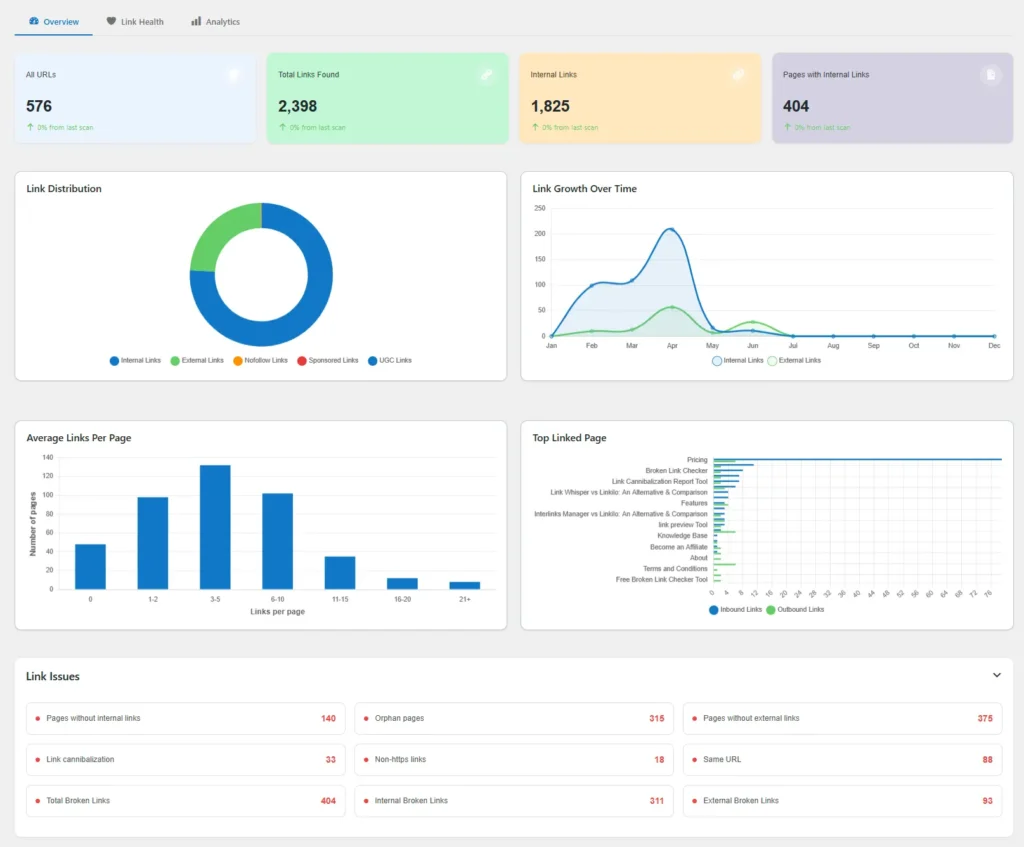
The dashboard is comprehensive. Maybe too comprehensive.
You get multiple tabs, sortable columns, and detailed metrics for everything. It’s powerful but can feel overwhelming if you’re used to simpler plugins.
Navigation through large datasets works well enough, though the interface could use some design thinking. This feels like software built by developers for developers.
Performance Impact You Should Know About
Here’s what to expect based on site size:
| Site Size | Posts | Expected Impact |
|---|---|---|
| Small | Under 500 | Barely noticeable slowdown |
| Medium | 500-2,000 | 100-200ms additional load time |
| Large | 2,000+ | Potential timeout issues on shared hosting |
Large sites might hit timeout issues on shared hosting. The plugin includes optimization features, but you’ll need decent hosting for smooth operation.
Playing Nice with Other Plugins
It works alongside major SEO plugins without conflicts. Yoast, RankMath, AIOSEO all work fine with this plugin.
Page builders are a different story. Elementor, Divi, and similar tools don’t play well with the internal link tracking. If your site is built primarily with page builders, this plugin loses a lot of value.
Caching plugins work fine, though you might need to exclude click tracking URLs for accurate data.
The Honest Pros and Cons
Every plugin review should include an honest assessment of strengths and weaknesses. But most reviews either oversell the benefits or focus on trivial complaints. Let me give you the real picture based on actual use across different types of websites.
The strengths of this plugin are genuinely unique in the market. The weaknesses are significant enough that they’ll disqualify it for many users. Understanding both sides will help you make the right decision for your specific situation.
What It Does Brilliantly
The analytics are unmatched. No other internal linking plugin gives you this level of data insight.
These features stand out:
- Link juice calculations with actual SEO value
- Professional CSV reporting for client work
- Systematic rule-based approach that scales
- One-time purchase in a subscription-heavy market
Where It Falls Short
The learning curve is steep. If you want plug-and-play simplicity, look elsewhere.
Major limitations include:
- No AI suggestions like current competitors
- Dated interface compared to newer tools
- Limited page builder compatibility
- Complex setup requiring technical knowledge
How It Stacks Against the Competition
The internal linking plugin market has exploded in the last few years. Everyone promises to solve your SEO problems automatically, but the approaches differ dramatically. Understanding these differences is crucial because choosing the wrong tool can waste months of effort.
Interlinks Manager competes in a space dominated by AI-powered solutions and simple automation tools. Its analytical approach puts it in a category of its own, but that’s both an advantage and a limitation.
Versus Link Whisper
Link Whisper gives you AI-powered suggestions and a prettier interface. But it can’t show you link juice calculations or provide the detailed analytics you get here. They also offer a one-click solution that lets AI do all of the internal linking, but be warned, it might cause some issues.
The choice is straightforward. Do you want automation or insight?
Versus Linkilo
Linkilo splits the difference with some analytical features and AI. But it doesn’t match the depth of data analysis you get with Interlinks Manager.

Versus Free Options
Free plugins like Internal Link Juicer handle basic automation. But without the analytical depth, you’re essentially flying blind.
For simple automated linking, free might be enough. For understanding what’s actually working, you need something more sophisticated.
Who Should Actually Use This
This is the most important section of any plugin review. Too many reviews skip this question or give generic advice that applies to everyone. The truth is that Interlinks Manager serves a specific type of user extremely well while being completely wrong for others.
Your decision should be based on your technical comfort level, business needs, and SEO strategy today. Let me break down the ideal user profiles so you can see where you fit.
Perfect For
These user types get the most value:
- SEO professionals who need detailed reporting
- Large content sites with thousands of posts
- Data-driven marketers who base decisions on metrics
- WordPress developers building custom strategies
Wrong Choice For
These users should look elsewhere:
- WordPress beginners wanting simple automation
- Sites built primarily with page builders
- Users preferring AI suggestions over manual work
- Budget-conscious users needing only basic linking
Get Started the Right Way
If you’ve decided that Interlinks Manager fits your needs, the next step is getting it running properly. This isn’t a plugin you can install and ignore. Success requires careful preparation, methodical configuration, and ongoing maintenance.
Most plugin failures happen during setup, not because of software bugs. Taking the time to prepare your environment and understand the configuration options will save you significant frustration later.
Before You Install
Check your hosting specs. PHP memory needs to be at least 256MB for medium sites, 512MB+ for large ones.
Set max_execution_time to 300 seconds minimum. The plugin needs time to analyze large link structures.
Make sure you have adequate database space. Analytics tables can grow substantially on high-traffic sites.
Configuration Best Practices
Start conservative with automatic linking settings. You can always increase limits as you get comfortable.
Test everything on staging first. Configuration changes can significantly impact your live site.
Monitor performance closely, especially during initial analysis runs.
Schedule periodic cleanup of analytics data to prevent database bloat.
Common Problems and Solutions
Memory exhaustion happens sometimes. Increase PHP limits or process analysis in smaller batches.
Slow analysis can be frustrating. Run it during low-traffic periods or upgrade your hosting.
Missing links might confuse you. Check exclusion rules and content type configurations.
The Bottom Line Decision
This plugin isn’t for everyone. And that’s actually a good thing.
If you want something that automatically creates perfect internal links without any input from you, this plugin won’t meet your needs. The AI-powered alternatives handle automation better.
But if you want to understand what’s actually happening with your internal links, this plugin delivers. If you need detailed analytics and professional reporting, it excels. If you make decisions based on data rather than hope, it provides capabilities you literally can’t get anywhere else.
The key question is simple. Are you the kind of person who wants to understand your SEO strategy, or do you just want it handled automatically?
Your answer determines whether Interlinks Manager is worth your time and money.
For me, having the data to make informed decisions beats having someone else make the decisions for me. But maybe that’s just how I think about SEO.
Consider your own preferences. Do you prefer understanding your tools or trusting them to work without explanation?
Frequently Asked Questions About Interlinks Manager
Get answers to the most common questions about choosing and using this WordPress internal linking plugin
Is Interlinks Manager better than Link Whisper for SEO?
It depends on your priorities. Link Whisper offers AI-powered suggestions and a more intuitive interface, while Interlinks Manager provides detailed analytics and link juice calculations that Link Whisper can’t match. Choose Link Whisper if you want automation, Interlinks Manager if you need data insights and professional reporting capabilities.
Does Interlinks Manager work with page builders like Elementor?
Interlinks Manager has limited compatibility with page builders. Internal links created within Elementor, Divi, or similar page builder modules may not be fully tracked or analyzed by the plugin. If your site is built primarily with page builders, this significantly reduces the plugin’s value and you should consider alternatives.
How much does Interlinks Manager cost compared to competitors?
Interlinks Manager Pro costs $39 as a one-time purchase, while competitors charge annually: Link Whisper ($97-347/year), Linkilo ($59-499/year). The one-time payment model offers excellent long-term value, especially for agencies managing multiple sites or users who plan to use the plugin for several years.
What makes Interlinks Manager’s link juice analysis unique?
Interlinks Manager calculates actual SEO value flowing between pages using “SEO Power” scores based on content quality, authority, and link structure. No other internal linking plugin provides this level of analytical depth. You can see exactly how much SEO value each internal link transfers, helping you optimize link distribution strategically.
Is Interlinks Manager suitable for WordPress beginners?
No, Interlinks Manager has a steep learning curve and requires technical knowledge for optimal setup. Beginners who want simple, automated internal linking should consider alternatives like Link Whisper or free plugins like Internal Link Juicer. This plugin is best suited for SEO professionals and data-driven marketers.
What server requirements does Interlinks Manager need?
For optimal performance, you need PHP memory of at least 256MB for medium sites (500-2,000 posts) and 512MB+ for large sites. Set max_execution_time to 300 seconds minimum. The plugin creates analytics tables that require adequate database space and may cause timeout issues on shared hosting for large sites.
Can I track which internal links people actually click?
Yes, Interlinks Manager tracks detailed click data including IP addresses, timestamps, source/destination pages, user agent information, and geographic data. This creates comprehensive reports showing which internal links drive actual engagement, helping you optimize placement and anchor text for better user experience.
Does the plugin slow down my WordPress site?
Performance impact varies by site size. Small sites (under 500 posts) see minimal slowdown. Medium sites (500-2,000 posts) experience 100-200ms additional load time. Large sites (2,000+ posts) may face significant impact during analysis and potential timeout issues on shared hosting. Consider upgrading hosting for large sites.
Can I export data for client reports?
Yes, everything exports to CSV format including all links, click data, SEO value calculations, and performance metrics. This makes Interlinks Manager excellent for agencies needing professional documentation and client reporting. The detailed analytics give you concrete data to demonstrate internal linking ROI.
Is there a free version available?
Yes, the free version is available on WordPress.org and includes basic internal linking functionality and simple analytics. However, the advanced features that make this plugin valuable – detailed click tracking, comprehensive analytics, bulk operations, and professional reporting – require the Pro version at $39.
How does automatic linking work without over-optimization?
The plugin includes built-in safeguards with customizable limits on links per post and intelligent anchor text variation. You can set rules based on categories, post types, and custom fields while maintaining natural link patterns. Start conservative with 3-5 links per 1,000 words and test in preview mode before going live.
Who should choose Interlinks Manager over alternatives?
Choose Interlinks Manager if you’re an SEO professional, agency owner, or data-driven marketer who needs detailed analytics and professional reporting. It’s ideal for large content sites requiring systematic link management and users who prefer understanding their tools over automated suggestions. Avoid if you want simple automation or use page builders extensively.
Linkilo does this for you
- AI Internal Link Suggestions : Get link suggestions a human editor would approve, and add them in one click without leaving the editor.
- Internal Link Click Analytics : Find out which internal links people actually click, and stop guessing which ones earn their place.
- Anchor Text Reporting Tool : See every anchor pointing at every page, and catch the over-optimized ones before Google does.
Jay - Linkilo
Jay's the brains behind cool tools like Linkilo, helping marketers rock their SEO game. He's all about data-driven strategies and using AI to boost results. He's been at this for a decade and loves figuring out what works (and what doesn't) to get more leads without paying a fortune. <a href="https://www.linkedin.com/in/jay-kang-80b103309/">Linkedin</a>